
Gameplay
The game at a glance
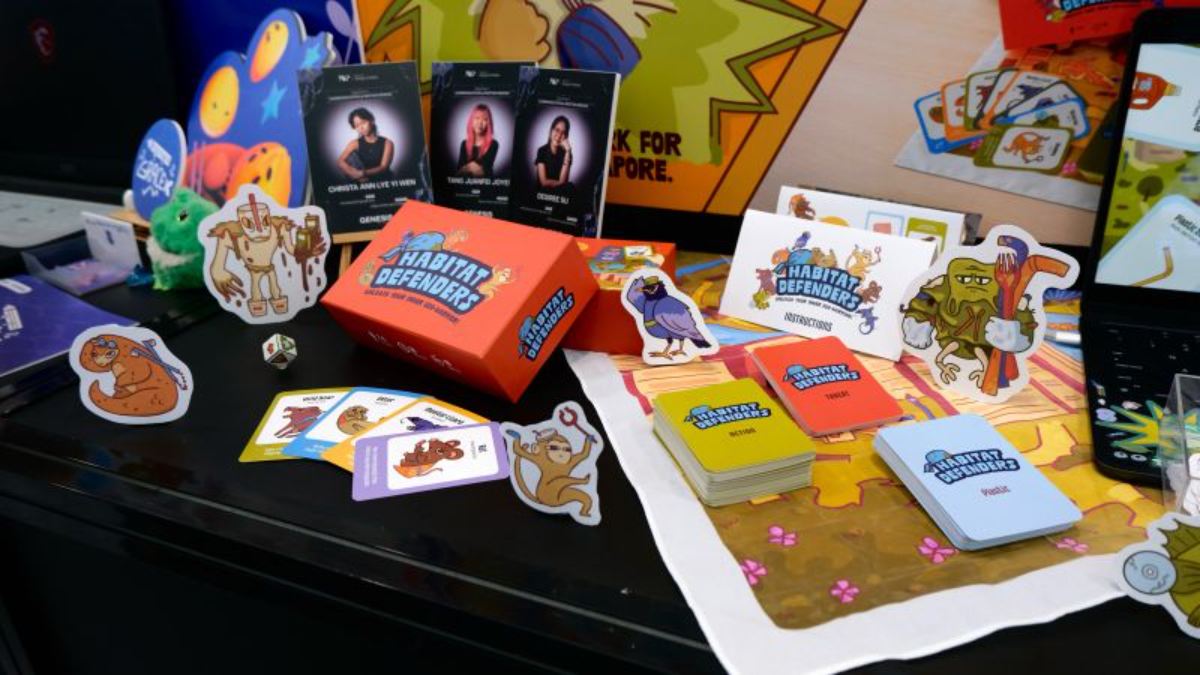
Habitat Defenders is a co-op card game about putting waste in the right bin. Players become animal heroes and protect Singapore's habitats from plastic villains by sorting waste and working together.
- Players2 to 8
- Ages10 and up
- Timeabout 30 minutes
- Good forclasses, CCAs and families
How it plays
The founders call it a co-op card game and educational kit that teaches children proper plastic recycling through play. Everyone is on the same team. Players make decisions together, sort different kinds of plastic and fend off plastic villains as they play through habitats found in Singapore.
In the photos from NYP Gradshow 2026 you can see three decks of cards marked Action, Threat and Plastic, animal cards such as the otter, wild boar, monitor lizard and rat, a play mat of a habitat, a die and the instruction booklet. The full rules are in the booklet.
"This game can help kids work together and make decisions."
Try a quick sorting round
Eight things you might throw away this week. Pick a bin for each one. The answers follow the National Environment Agency's guidance for homes in Singapore.
0 of 8 sorted
-
Empty drink can
Blue bin. Cans are one of the everyday recyclables NEA lists. Tip out any drink first.
-
Very oily takeaway container
General waste. NEA says containers that would need too much washing, like very oily ones, can go in general waste.
-
Used AA batteries
E-waste bin. Batteries should never go in the blue bin or a general bin. E-waste bins are in public places such as town centres.
-
Yesterday's newspaper
Blue bin. Newspaper is one of the most common recyclables in any home.
-
Leftover fried rice
General waste. Food waste from homes isn't collected for recycling, and in the blue bin it dirties everything else.
-
Rinsed shampoo bottle
Blue bin. Plastic bottles are fine once they're rinsed. Ignore the number on the bottom: NEA says it doesn't tell you whether something can be recycled.
-
Old mobile phone
E-waste bin. Wipe your data first, then drop the phone at an e-waste collection point.
-
Milk carton, rinsed
Blue bin. Drink cartons are recyclable, as long as no milk is left inside.
Singapore's blue bin in one minute
One blue bin takes four kinds of material: paper, plastic, glass and metal. You don't sort them yourself. Recycling trucks take everything to a Materials Recovery Facility, where it's sorted by type.
Do
- Rinse bottles and containers that still have food or drink in them.
- Put glass bottles and jars in too. Breakable glassware is accepted.
- Take batteries and old electronics to an e-waste bin or collection point.
Don't
- Put food waste in the blue bin. It isn't collected for recycling from homes.
- Scrub very oily containers for ages. NEA says those can go in general waste.
- Go by the number on plastic. It's a code for manufacturers, not a recycling guide.
- Put batteries in any ordinary bin, blue or general.
Sources: NEA Recycling FAQs, NEA: Where to recycle e-waste, NEA: National Recycling Programme.
Want the full game?
Each set is $49.90, and pre-orders take 1 to 3 weeks.